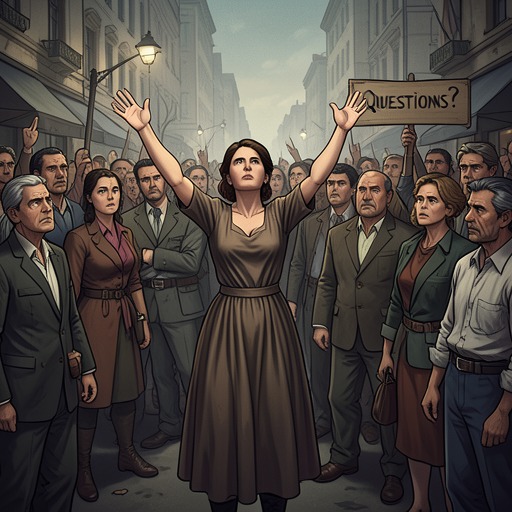
Margo Fairchild’s “One Woman’s Story” Talk at the Senior Center
Mrs. FletcherMargo Fairchild’s “One Woman’s Story” Talk at the Senior Center turns a public lecture into a test of who gets to define Margo’s life: she presents herself in her own words, while some listeners respond by scrutinizing her body, questioning her identity, or reaching for the person they remember. The evening’s sharpest contrast is between the bluntness of Margo’s self-introduction and the audience’s effort to make her explain herself on its terms.
Announcement and Expectations
The lecture is advertised on a hardback poster propped on an easel near the front desk. Its format is formal and spare: a November monthly lecture, scheduled for Wednesday at seven, featuring Margo Fairchild, Ph.D., under the title One Woman’s Story. The poster’s enlarged headshot shows Margo smiling blandly, an image one elderly visitor finds difficult to interpret. Wearing a dark green tracksuit with pale green piping, tight white curls, and a Halloween-themed Band-Aid on her cheek, the woman asks what the event is about. Amanda Olney explains that Margo is a local professor and an inspiring person, but the answer does not satisfy the visitor, who continues to demand an explanation.
Before speaking, Margo sees a larger crowd than she expected, with at least two-thirds of the audience women. The welcome is not uniformly attentive: an elderly man snores in the second row, his soft gargling sound coming and going, while the response to Margo’s check that the microphone can be heard includes some disgruntled murmuring. Margo looks to Eve Fletcher in the front row, who gives her a thumbs-up. The small gesture offers encouragement, but the room’s uneven attention foreshadows the distance between the story Margo has come to tell and what some listeners will choose to hear.
Margo Takes the Floor
Margo steps out from behind the podium rather than remaining framed by it. She gives the audience time to look her over: her height, hair, breasts, hips, and muscular legs. The inspection is familiar enough that she understands its social script, but not comfortable enough to feel natural. She even turns so the audience can see her from behind, likening the scrutiny to a beauty pageant in which women are contestants and spectators act as judges. Her wry awareness of the performance does not make the gaze disappear; it shows how thoroughly public appraisal has become part of the conditions under which she is expected to appear.
Then Margo states the central fact of her story directly: “My name is Margo Fairchild, and I used to be a man.” The declaration gives her control over the introduction of her past. She does not wait for an audience member to supply an old identity or present her transition as a rumor to be investigated. The lecture’s title promises an individual story, and Margo begins by naming herself, making the terms of that story clear before the room can impose its own.
A slideshow accompanies the talk, displaying photographs from Margo’s early life: baby pictures, a bright-eyed toddler, birthday hats, Halloween costumes, Christmas presents, Cub Scouts, Little League, and a childhood smile with a missing tooth. The images give the audience a sequence of ordinary biographical particulars rather than an abstract account. Yet the photographs also place Margo’s past on public display, making the distance between private memory and a crowd’s scrutiny part of the lecture’s form.
Questions and Rejection
As the slideshow proceeds, Margo feels the audience slipping away. Her jokes receive no laughter; some people whisper loudly, possibly making derisive comments, and nearby spectators snicker. The applause after the main presentation is barely more than politeness. The failure becomes unmistakable when the lights come back up for questions: the faces before her look blank, icy, disgusted, or confused. Margo invites the audience to ask anything, but the silence that follows feels heavy rather than open.
A woman in a lavender turtleneck eventually raises her hand and asks which restroom Margo uses. The question, and the murmur of approval it draws, reduce the evening’s account of a life to a point of public curiosity about access to a gendered space. Margo answers that she uses the women’s room, adding that she would cause quite a stir if she went into the men’s room. She forces a smile, then gives the audience time to discuss the issue among themselves before calling on someone else. The exchange shows how readily a question framed as curiosity can redirect attention away from the substance of what she has shared.
The Former Coach and the Ending
The next question comes from a man Margo recognizes as the loud, disruptive neighbor of Julian Spitzer, who had disturbed the slideshow. He stands with his arms spread and calls her Mark, asking whether she recognizes him. Margo winces but keeps her composure: she no longer goes by that name and asks him to call her Margo. She identifies him to the audience as Coach Huff, a local legend whose St. Benedict’s team was a longtime rival and one of the state’s best. A few people clap for the coach, but he remains fixed on the name and person he remembers.
Coach Huff asks what happened and why Margo would do this to herself. She answers that this is who she is. His response—that she needs help and cannot live like this—casts his concern as a denial of her own account. Margo replies, somewhat frostily, that she is doing just fine and is happier now than at any other time in her life. The exchange makes the lecture’s conflict personal: even someone with a shared history and standing in the community treats Margo’s present identity as a problem, while she refuses to let his memories overrule her self-understanding.
At that moment, Dumell enters through the back door, unzipping his leather jacket slowly and glancing warily at the older white audience before grinning at Margo and giving her a sheepish wave of apology for being late. Margo wants to blow him a kiss but settles for a fleeting smile before returning to her duties and asking whether there are further questions. The lecture does not conclude with a sudden conversion of the room: its reception remains awkward and resistant. Instead, it ends with Margo still in command of the microphone and still able to state, in front of the people challenging her, that her life is her own and that she is happy in it.